
Imam Al Haddad in The Lives of Man: An Examination of Ontological Presuppositions Concerning the Soul

Updated: Jun 14

Introduction:
We find ourselves in the midst of a strange society, edging towards perilous terrain which seems to offer no path of return. From the vast plethora of nefarious ideological cancers that the 21st Century draws forward, particularly in the context of ‘the West’[1], the most striking is an ontological misplacement of the nature of the Soul, with disturbing questions arising as to its very existence.
This, coupled with economic turmoil with the bolstering of a superficial mode of living, has exacerbated a quality of existence that is fueled by a material drive, devoid of prompting deeper questions that should resonate with Spirit, Unseen Realities and cognitive contemplations, which in turn would allow one to uncover things as they truly are. Essentially, such a way of life prevents a holistic manifestation of Nafs Ul Amr as a broader notion of objective reality.
From a micro-paradigm, this translates to the average individual struggling with an unsettling lacuna between essential identities within their very beingness; between Reason and Revelation, Material and Spirit, Money and Wealth[2]. The Muslim, therefore, desperately seeks refuge in ritualistic acts of piety, hoping to find some solace; in some cases, being self-deceived to think that he has reached the state of Eudemonia solely through the medium of such outward practices.
In reality, to reach such a psycho-spiritual pedestal, one must tackle much deeper presuppositions. From amongst them are two that will be tackled in this article: the existence of the Soul and its traverse through the metric of time (albeit it being an entity distinct and separate from the tool of time).
Very few authors have unravelled the material layers of the spiritual dimension as astutely as the erudite scholar, Imam Abdallah Al Haddad. Throughout the Lives of Man, Imam Al Haddad presents the journey of the Soul, presupposing its existence and its endlessness, through the presentation of a 5-Part categorisation. This taxonomy reflects the theocentric day of the believer through a cyclic routine of 5 daily prayers.

You can purchase the book by pressing the button below.
The Taxonomy of Imam Al Haddad:
Life Pre Conception (From the Realm of Souls to the Mother’s Womb).
Life in this Lowly World (From Birth to Death).
Life in the Barzakh (The Transfixed Period between Death and Judgement).
Life on the Day of Accountability (The Day of Judgement as a distinct reality).
Life in Endlessness (Perdition or Salvation).
The First Realm:
The first realm is life pre-conception, referring to the realm of the Souls, or A’lam Al Arwah, and the formation of the body in the mother’s womb. By beginning the human journey from this vantage point, Imam Al Haddad addresses some very pertinent existential questions regarding the Soul, many of which have gained particular prominence in the aftermath of the Renaissance Period and the subsequent rise of the theory of Naturalism.
From them is the concept of knowledge according to the theory of Naturalism. This is the commonly held philosophical belief that has gained prominence in the past few hundred years, namely that knowledge is only defined through the parameters of the tangible world, in some fringe instances, even denying rational deductions as a means of reaching certainty.
If one concedes a reality before this world, our Soul must also have a corpus of ingratiated knowledge which was amassed pre-conception. Our forgetfulness, through veils of negligence from the Divine Reality, of this past ordeal, does not negate its actuality.
It was in this vein that the great Companion of the Prophet of God, Sayyiduna Ali, stated that he remembered making the Oath of Testification to God in the Realm of the Souls that the Quran vividly describes:
‘Am I not your Lord? Indeed, we Testify…’
How could an individual remember life before life? The starstruck Muslim who lacks metaphysical training, or the hardened atheist who outright denies reality beyond the material, may find themselves asking. The answer is found internally, within the confines of the Self, simply because it was you who encountered that Divine Ordeal.
The first reality points towards meta-cognition (Marifa). This is for one to journey within an internal traverse, urging one to find God through the Soul itself. From a practical paradigm, the Ulama urge the practice of Muraqaba, which can be manifested through moments of contemplation in a dark environment before the end of the night. As such, the individual will fixate on his dialogue with his Creator and attempt to eliminate all externalities.
Imam Al Haddad provides a moderate standpoint in terms of this acute awareness before conception, in comparison to other thinkers, where he states:
‘As for the rest of the progeniture, it is possible that they had some kind of awareness during those conditions, especially at the time when they pledged their covenant, but neither the awareness nor the knowledge persisted with them as it did with him (the First Man).’
It is in this capacity that one may realise the constant actualisation of Divine Unveiling and Unpouring onto the realm of the celestial contingents.

The Second Realm:
The second reality is designed as a lowly plain, manufactured as a realm of volition; the testing ground for the moral agent. It is this volition which amounts to a permanent ontological designation in the Hereafter. In essence, one’s actions in this world dictate the fate one is to share for eternity thereafter.
Imam Al Haddad states regarding the Dunya:
‘This, which is the middle of their lives, is also their purpose. It is the period when man is held accountable for [responding to] the divine injunctions and prohibitions, the consequences of which will be reward or punishment, endless happiness in the proximity of God, the High and Majestic, or perpetual torment and remoteness from Him.’
It is through this amalgamation of contingent acts into a final scroll that will act as a testament to one’s lot in the traverse through eternal reality.
The Third Realm:
The third reality is the first eschatological marker in the eternal narrative. It connotes Barzakh as a realm of static reality, neither manifesting teleological salvation nor damnation, but rather acting as a halfway house between the toil of actions and the recompense for them.
Imam Al Haddad states regarding the third reality:
‘The Intermediate Realm is the abode which lies between the world and the life to come. It has more affinity with the latter and is in fact, a part of it. It is a place where spirits and spiritual things are predominant, while physical bodies are secondary but share with the spirits in their experiences, whether felicity and joy, or torment and grief.’
It is this intra-state mode of being, which has been previously alluded to, that Barzakh stands as, allowing for actual transmission of lived reality between the Realm of the Dunya and itself.
The Bifurcation of Life and Death:
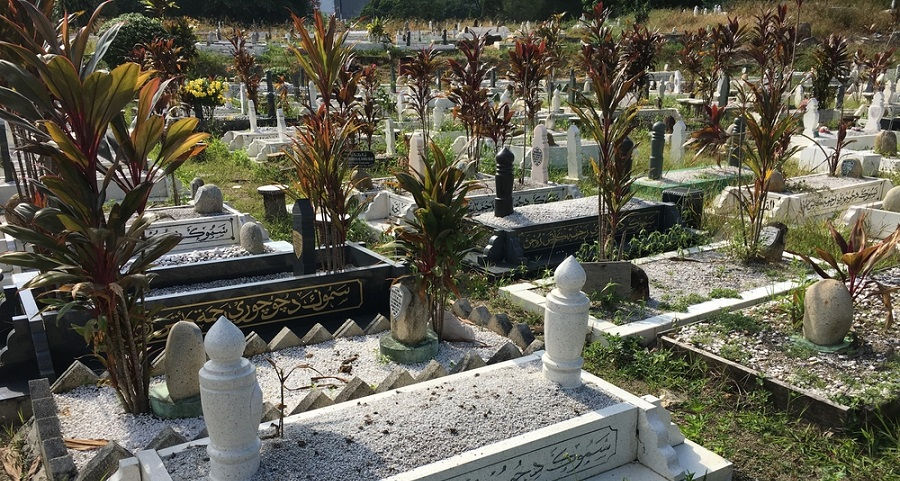
Following on from the paradigm of naturalism, the modern mind makes an intrinsic distinction between life and death. To such an extent that one is made to believe that any notion of cross-dimensional discourse is tantamount to make-believe, or at the very worst, outright blasphemy. In essence, to postulate that the dead can benefit the living as the living can benefit the dead is seen as a nonsensical proposition, even in the context of theology.
Quite ironically, this discussion often gets misplaced into the realm of theological polemics, whilst in reality it pertains to metaphysical egology in examining the Nature of the Soul and, by extension, the bifurcation of life and death.
As Imam Al Haddad states:
‘Know that the deeds of the living are shown to their dead family and relatives; if these deeds are good, they rejoice and are optimistic, and they pray for them to have firmness and rectitude, but if these deeds are otherwise, they feel sad and hurt, and they pray for them to be guided and given success in doing good.’
Further explicating on this notion through scriptural proofs, Imam Al Haddad highlights that there is an undeniable causal relation between the realms of the living and the dead, ultimately lingering in an intra-state beingness; constantly connecting.
If one were to, by natural extension of the notion of Naturalism, deny existence beyond the five senses and the paradigm of empiricism, one would be obliged to deny any notion of a metaphysical soul. This results in insurmountable dilemmas for the modern atheist in navigating around his own personhood. This, in addition to a superficial lifestyle devoid of access to the natural human habitat, can be seen as the prime catalyst for contemporary enigmas, such as gender dysmorphia. In essence, if one cannot ground beingness into the nature of the soul, how can one find contentment in only ever nurturing ‘one side of the coin’ (the material without the psycho-spiritual)’?
The Fourth Realm:
The fourth reality signifies the notion of duty and responsibility through the exercise of volition, in knowledge of The Accountability that awaits. In essence, it explains the centrality of self-accountability (Muhasaba) in the tradition. In this manner, these two temporal opposites (pre-conception and after-life) allude to a singularity: The Soul finding the Soul Maker.
Imam Al Haddad states regarding this:
‘The Fourth Life extends from the time when a person leaves his grave for the Resurrection and Gathering, until the moment when mankind enter the Garden of the Fire’,
Another observation that can be derived from Imam Al Haddad’s work is his delineation of the Day of Judgement as a distinct reality from the five stages. This provides a profound insight into the centrality of accountability for the universal volitions of all agents of action; the number of God’s creations is uncountable: the collective sum of the actions of those beings is insurmountably more.
With this in mind, the Reality of gathering on that Day is to bring forth the task of holistic accountability. This will draw from the actions of every member of the Sui Juris class, from Man and Jinn, and beyond, to the wrongdoings committed by animals, to such an extent that an ant that wronged another ant will pay its due.
The Fifth Realm:
The fifth and final dimension, according to Imam Al Haddad’s temporal taxonomy, is eternity either in the abodes of salvific bliss or painful damnation.
There is a common notion that once an individual enters paradise, they are no longer in want of anything. Whilst this is true in terms of material progression and physical ease, it can be seen as a rather inaccurate notion from the realm of Divine Connection. According to the Elect, one can never actually reach the Ultimate Truth. Instead, one will swim in the oceans of Divine Knowledge and Certitude- with no end. In essence, how can a contingent being reach the Eternal Creator?
Imam Al Haddad states regarding the eternal dimension:
‘The fifth life extends from the time the people of the Fire enter the Fire and the people of the Garden enter the Garden, and continues into unending, limitless eternity.’
Conclusion:
The classical text acts as an allusion to the traverse of the Human Soul. As such, it provides the modern thinker with much scope for thought, both in actualising one’s potential when journeying towards the theocentric teleological imperative of attaining proximity to the Divine, and in unravelling the hidden layers buried within one’s own Self.
It recalibrates the trajectory of the believer towards a theocentric telos; constantly striving through engaging in acts of Mujahada (struggle against the base) in the ultimate hope of attaining an experience of Mushahada (Divine Attestation).
In an age riddled with temptations and delusions, it is incumbent upon the believer to return to the Path of the Elect through analysing the mirror which reflects the Internal Self. It is only through constant battle with the beastly Hyde that Jekyll can emerge victorious.
Notes (Click number to return to text):
[1] The writer is cognisant of the cliche bifurcation of ‘us’ and ‘them’ which commonly arises in discussions of ontological designations. ‘The West’ in this context is not referring to an intrinsically evil entity engaging in a permanent clash against Islam. Instead, it refers to the figurehead of social debauchery w
hich has plagued all corners of the world in this era.
[2] A disparity has been highlighted here between money as a quantitative metric of increase and wealth as a qualitative tool enhancing one’s state of reality.


Comments